
Most AI projects we see across the Gulf are quietly failing. Not loudly. There’s no crash and no post-mortem. The pilot just goes quiet, the enthusiasm fades, and a year later, the business is roughly where it started, only now with a subscription it isn’t really using.
It’s almost never because the technology doesn’t work. The technology works. These projects fail because of who was put in charge of them, and because nobody was honest about where the business actually stood before they began.
Both are worth unpacking because if you get these two things right, you are already ahead of most of the market.
AI is not an IT project
When AI lands in a business, it usually gets handed to the CIO. On paper, that makes sense. It’s new technology, and technology goes to the technology team.
But the CIO’s job is to keep things secure, compliant and scalable, usually on a tight budget. That is exactly the right job for a CIO and exactly the wrong job for AI. Governed as a risk, AI becomes a risk to be contained. And contained is precisely what it stays.
Here is the better way to think about it. AI isn’t a system you roll out. It’s electricity. It doesn’t do one defined job. It amplifies whatever your business already does, across every function, all at once. Which means the person who owns a given outcome has to own how AI gets used to reach it. Not IT. The leader who runs the call centre. The head of marketing. The person responsible for the sales floor.
The businesses getting real value from AI right now, and there aren’t many, are not the ones with the most polished AI strategy deck. They are the ones where a business owner picked one genuinely painful process and shipped something that actually works. That is the whole difference.
If your AI programme is a line item on the IT roadmap, that is your first problem.
The four things that actually decide whether AI sticks
The second reason projects fail is that most leaders can’t honestly say where their business sits before they start. They feel behind, or they feel fine, but they don’t actually know. And you can’t close a gap you haven’t named.
In our experience, four things decide whether AI takes hold or quietly dies. They are worth being honest with yourself about.
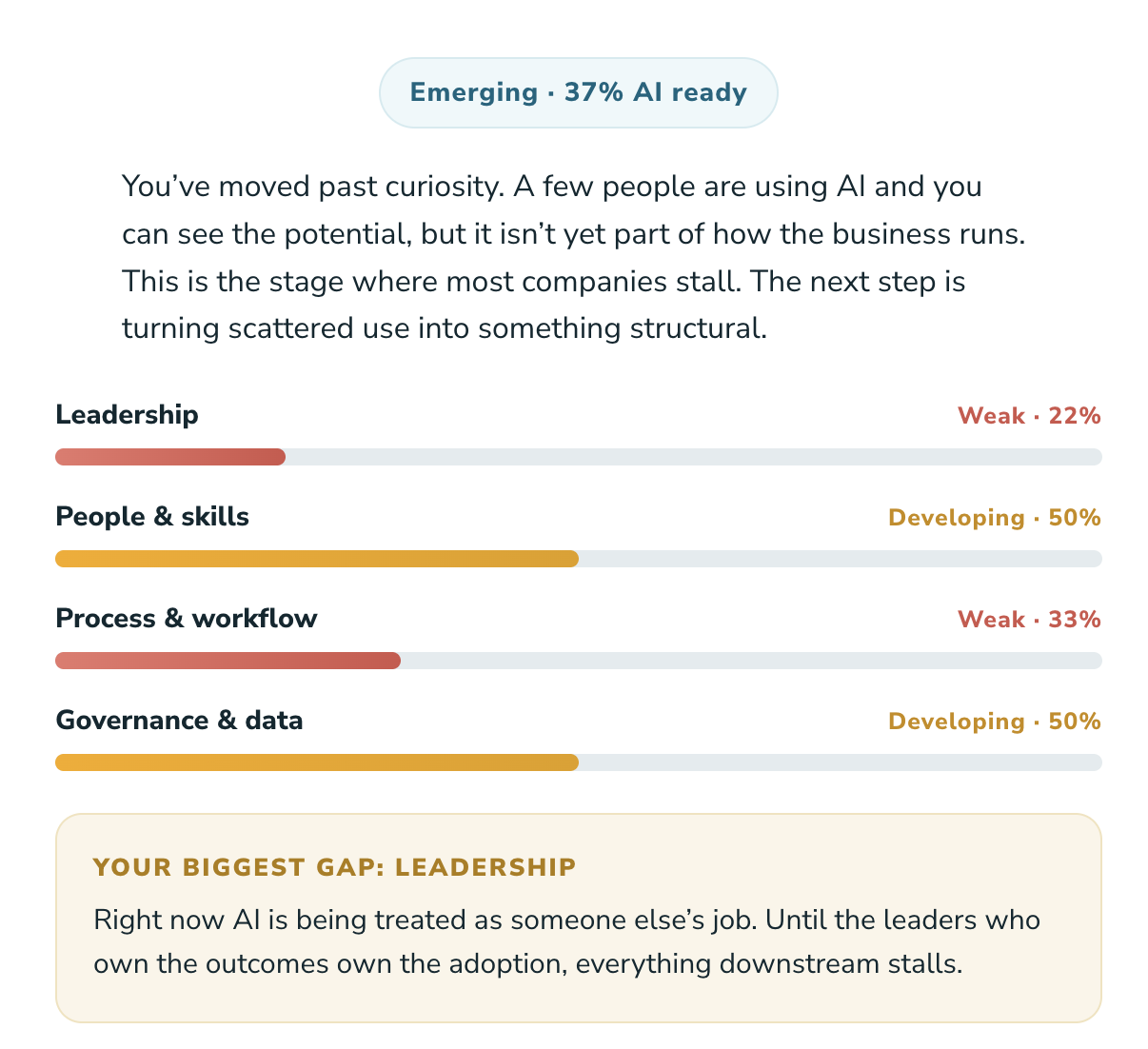
Leadership. Are your executives actually using AI in their own work, or are they delegating it and just talking about it? This is the big one. When a CEO becomes a real user, they stop asking abstract questions and start seeing exactly where AI fits, and the rest of the company follows their lead. When leaders stay hands-off, adoption stays theoretical.
People and skills. Beyond a couple of enthusiasts, is your wider team genuinely capable of using AI in their real roles? Enthusiasm from a few people is not a capability across the business. Without structured, role-specific enablement, most of your team never gets past writing the odd email.
Process and workflow. Is AI in any real workflow, or is it still just ad-hoc chat? Speeding up individual tasks feels productive, but changes very little. The value is in redesigning how work actually happens, not in a faster typewriter.
Governance and data. Do your people have sanctioned tools and clear guidelines, or are they left to work it out for themselves? This is the quiet killer, especially in regulated businesses across the region. If people aren’t sure what is allowed, they either hold back entirely or take risks you don’t want them taking. Either way, you lose.
Notice that only one of those four is really a technology question. The other three are leadership, capability and clarity. That is the point.
Find out where you actually stand
Reading this, you probably have a rough sense of which of those four is your weak spot. Most leaders do. But a rough sense is not a straight answer, and a straight answer is what you need before you spend a dirham or a day on this.
So we built a way to get one.
It is a short AI readiness assessment. Nine questions, about three minutes, on your phone between meetings. It scores your business across those four dimensions, gives you an honest overall number, and tells you your single biggest gap and the fastest way to close it.
It is not a lead-magnet quiz that tells everyone they are doing brilliantly. Some of the results are uncomfortable. That is deliberate, because an uncomfortable but accurate number is far more useful than a flattering, vague one.
You can take it here: https://xanadu.co/ai-readiness/
Whatever you score, you will walk away knowing exactly where you stand and what to do next. Which, given where most AI projects end up, already puts you ahead.